Purpose
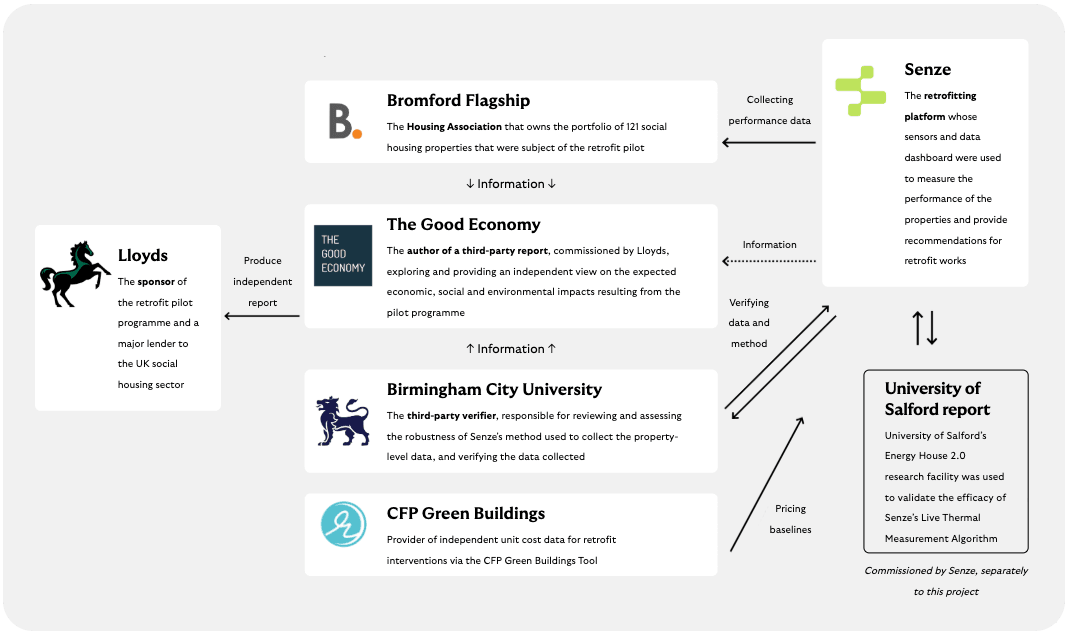
To support the industry’s exploration of potential solutions to this challenge, Lloyds sponsored a pilot project with Bromford Flagshipa, a housing association, and Senze, a technology provider.
The pilot tested the use of monitoring technology in a sample of 121 homes to measure actual thermal performance and compare this with modelled EPC data. The technology platform then used that real-time property-level data to suggest which properties to target for retrofit, and the specific interventions likely to be most effective in upgrading the performance of each individual property to the standard of an EPC C, on a granular, room-by-room basis. This service is delivered at a typical cost of £1,500 per property.
The project then assessed the recommended retrofit works and examined the costs and potential implications of delivering them against Bromford Flagship’s expected spend based on a traditional EPC-led approach.
The pilot set out to test a central hypothesis: how can sensor-generated measured data provide the intelligent insights needed to make better retrofit decisions? This question is considered relative to a traditional EPC-led approach while balancing environmental, social and economic outcomes in the context of the commercial and regulatory constraints that the social housing sector must work within.
Many of the findings are also likely to be of relevance to other types of property, including owner-occupied housing, other residential tenures for rent, and commercial real estate, particularly in older stock requiring retrofitting to meet new environmental standards.
a Bromford merged with Flagship on 28 February 2025 to create Bromford Flagship, an 80,000-home housing association. For this project, we primarily interacted with Bromford, and most of the homes included in the pilot sample were originally from Bromford’s portfolio, with a small proportion from Flagship’s portfolio.